
Menu

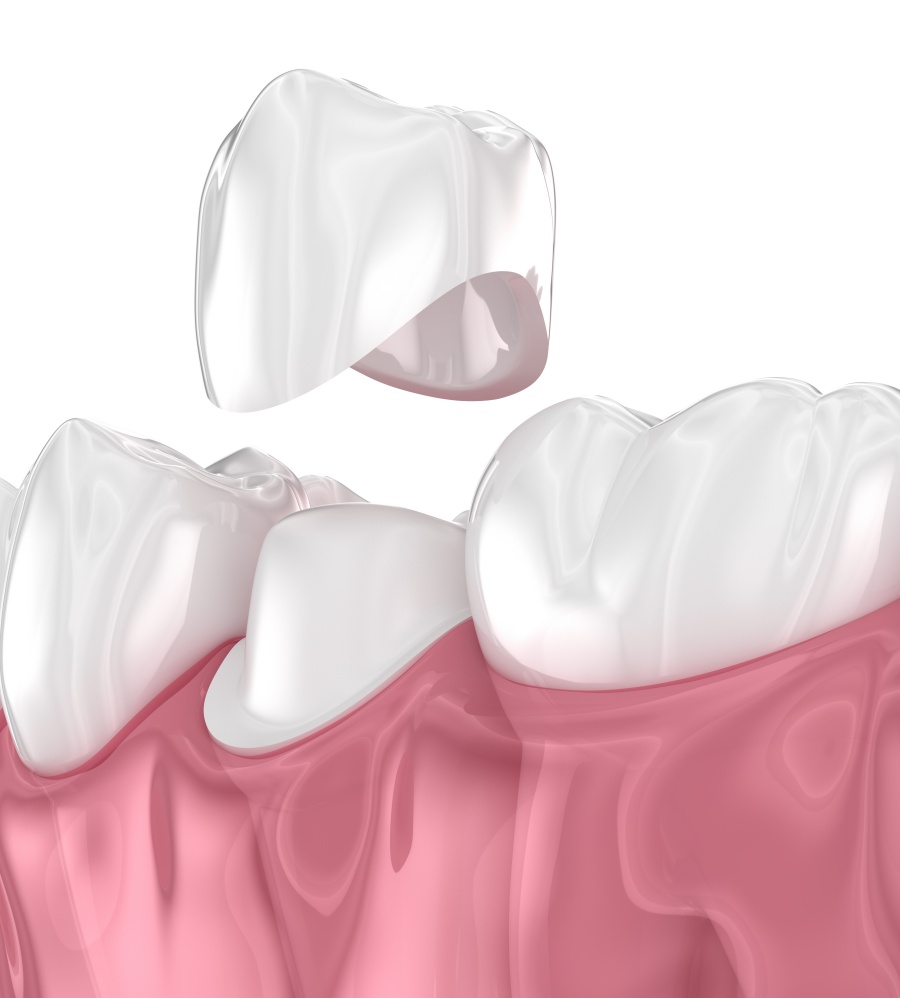
Dental crowns are caps which are placed over teeth and held in place with a specialist adhesive or cement.

Wash Common Dental

They can be used as a protective cover for badly decayed or fractured teeth, as a permanent restoration for teeth with large fillings, or to correct minor problems such as spacing, irregular shape or severe discolouration.

They are also often used to restore root canal-treated teeth to provide them with strength and to provide these teeth with a good seal to avoid reinfection.

The crown preparation procedure

  • At your first appointment, your dentist will carry out a thorough clinical examination using radiographs. This will determine whether or not a dental crown is necessary and if the root of the tooth is problem-free. Your dentist will also be able to advise you on material choices, what the treatment involves and also address any other concerns you may have.
  • At your second appointment, the teeth to be crowned will be prepared. Old, longstanding fillings need to be removed, and the tooth cleaned before being replaced with a new core. This involves reducing the tooth size (usually under local anaesthetic) to create space for the crown.
  • This is followed by an impression or scan of the prepared tooth. This will then be sent to a laboratory where a skilled technician will fabricate the crown. In the meantime, a temporary crown will be fitted to your trimmed tooth.
  • At your final appointment, the temporary crown is removed, and the tooth surface is cleaned. The new crown was then permanently cemented.

Crowns are durable restorations; however, the underlying tooth can still be susceptible to decay or gum disease if not cared for correctly.

Book Treatment Back to General Dentistry

Wash Common Dental
treatment inner bg1

Longevity and crown care

The most vulnerable part of your crown is the margin or junction between the tooth and the crown.

Daily brushing, flossing and using interdental brushes are encouraged to help keep the margin clean and prevent disease. Regular hygienist visits are also encouraged to help care for restorations and remove hard plaque. In order to prevent your crown from getting chipped, avoid chewing excessively hard items such as ice and bones. Crowns can also be pulled off with sticky food, such as toffee.

Get in Touch

Frequently asked questions

What are crowns made from?

A dental crown can be made from a number of materials including plastic, ceramic or metal alloys. It’s also possible to use a combination of metal and ceramic in order to maximise strength and simulate the appearance of natural teeth.


Take the next steps and book a consultation

Get in Touch

Contact

Get in touch

Wash Common Dental

Our partners

Our partners

Our partners

4.7
Google-review